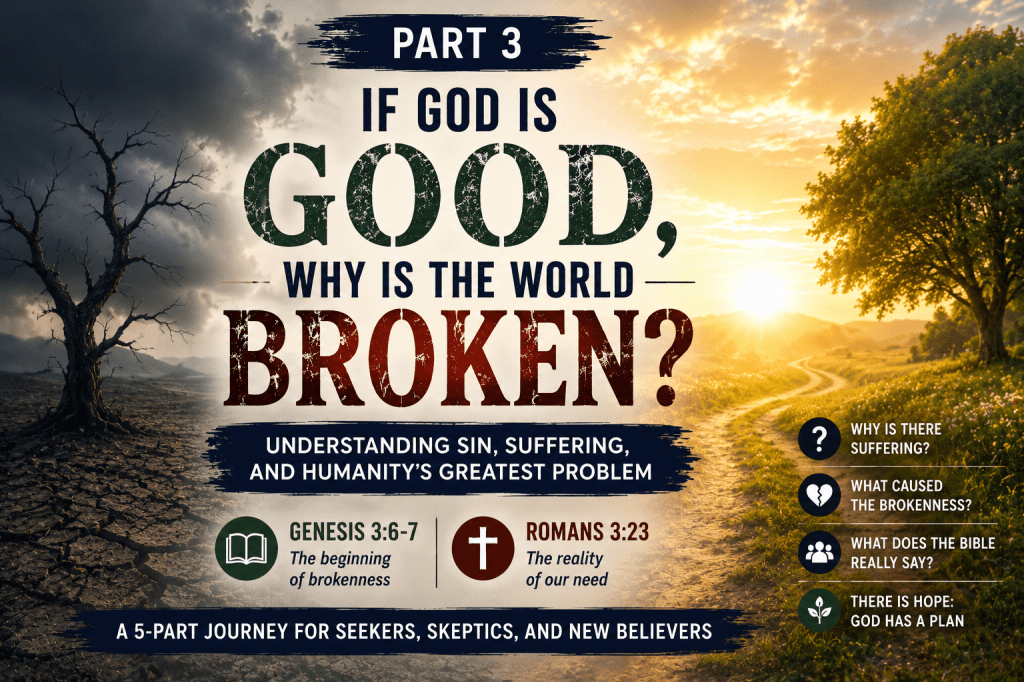
Understanding Sin, Suffering, and Humanity’s Greatest Problem
Key Scriptures Being Discussed
Romans 3:23 (NKJV)
“For all have sinned and fall short of the glory of God.”
Genesis 3:6-7 (NKJV)
“So when the woman saw that the tree was good for food, that it was pleasant to the eyes, and a tree desirable to make one wise, she took of its fruit and ate…”
Introduction
In Part 1, we explored the question:
Does God exist and can we know Him?
We discovered that God has revealed Himself through creation, Scripture, and ultimately through Jesus Christ.
In Part 2, we examined God’s character through Exodus 34:6-7 and learned that God is merciful, gracious, patient, good, truthful, forgiving, and just.
But a difficult question remains.
If God is good, loving, and all-powerful…
Why is the world so broken?
Why do we experience pain?
Why is there suffering?
Why do relationships fall apart?
Why do people hurt one another?
Why do sickness, violence, addiction, depression, death, and evil exist?
These questions have caused many people to doubt God’s existence or question His goodness including myself in the past.
Some conclude that if suffering exists, God must not be good while others assume God simply doesn’t care. Still others believe God is powerless to stop evil.
The Bible offers a very different explanation.
Scripture teaches that God created a world that was originally good. The brokenness we experience today is not the result of God’s failure. It is the result of humanity’s rebellion against Him.
To understand why the world is broken, we must go back to the beginning.
My Story: Looking Everywhere but the Mirror
For much of my life, I looked at the problems in the world and blamed everything around me. I blamed circumstances, other people, and situations that seemed unfair. What I failed to recognize was that the brokenness I saw in the world also existed inside of me. The Bible calls this reality sin. Unfortunately, that word is often misunderstood. Many people hear the word “sin” and immediately think of religion, condemnation, or a list of bad behaviors. Yet sin is far deeper than behavior alone. At its core, sin is humanity’s tendency to live independently of God, simply meaning to choose our own way instead of His. This was something I specialized in.
As I began reading Scripture, I came to a very uncomfortable realization that the problem was not simply that I lived in a broken world; the problem was that I was part of the brokenness. The same is true for every person who has ever lived. Coming to terms with that truth was not easy, but it became the beginning of genuine hope for me. Until we understand the problem, we cannot fully appreciate God’s solution. Recognizing our need is what prepares us to receive the grace, forgiveness, and new life that God offers through Jesus Christ.
Genesis 3:1-24
Let’s look at the context of these verses. Genesis 1 and 2 describe God’s perfect creation, everything God created was declared good. Humanity enjoyed fellowship with God and there was no death, suffering, disease or shame. There were no conflicts or broken relationships.
No fear.
Adam and Eve lived in perfect harmony with God and with one another.
Yet God gave humanity something essential:
The freedom to choose.
Love cannot be forced. For a genuine relationship to exist, there must be a genuine choice. God placed a tree in the Garden and gave one command. Adam and Eve were free to enjoy everything else.
The command was simple.
Trust God.
Unfortunately, they chose otherwise.
How can we interpret this?
The Serpent’s First Attack
The serpent begins by questioning God’s Word.
“Has God indeed said…” (Genesis 3:1)
Notice that Satan’s first strategy was not outright denial, it was doubt. Whenever people begin questioning God’s truth, they become vulnerable to deception. The same strategy continues today.
The Desire for Independence
Eve saw that the fruit was desirable and unfortunately, she believed the lie that she could determine good and evil for herself.
At its core, sin is humanity’s attempt to replace God with self.
Sin says:
“I will decide what is right.”
“I will determine truth.”
“I will live according to my own desires.”
This attitude remains at the heart of every one of us.
The Immediate Consequences
After Adam and Eve sinned:
- Shame entered the world.
- Fear entered the world.
- Guilt entered the world.
- Separation from God entered the world.
The relationship that God created was fractured and humanity’s greatest problem was no longer external, it was spiritual.
The Long-Term Consequences
The effects of sin spread throughout creation.
Because of sin:
- Relationships became broken.
- Work became difficult.
- Pain entered human experience.
- Death entered the world.
- Creation itself was affected.
The world we experience today is not the world God originally created.
It is a fallen world.
Romans 3:23
Now we can examine what the Apostle Paul is explaining about humanity’s condition before God. After examining both religious and non-religious people, Paul arrives at a universal conclusion. No one is exempt, naturally righteous or innocent.
How can we interpret this in greater detail?
“For All Have Sinned”
Notice the word “all.”
Not some.
Not most.
All.
Every human being except Jesus Christ has sinned.
This includes:
- Rich and poor
- Religious and non-religious
- Moral and immoral
- Educated and uneducated
Sin is humanity’s universal condition.
“And Fall Short”
The phrase describes missing the mark. God’s standard is perfection and humanity continually falls short. The issue is not whether we are better than someone else. The issue is whether we meet God’s standard. And none of us do.
“Of the Glory of God”
Humanity was created to reflect God’s glory and sin distorts that purpose. Instead of living for God, people often live for themselves. This separation from God’s design is at the root of humanity’s brokenness.
Why Does God Allow Suffering?
This is one of the most common questions people ask me and I also hear it a lot in general discussions. The Bible teaches that suffering exists because sin has corrupted God’s creation.
It is really important to understand that not all suffering is directly connected to personal choices.
Sometimes innocent people suffer, natural disasters occur, sickness strikes unexpectedly.
These realities exist because we live in a fallen world, yet God has not abandoned His creation.
The Bible is not the story of God ignoring suffering, it is the story of God entering our suffering.
In Jesus Christ, God stepped into a broken world to rescue broken people.
What About My Sin?
At this point, many people begin thinking about the sins of others however the Bible invites us to look inward first.
Before asking: “What’s wrong with the world?”
We should ask: “What’s wrong with me?”
This isn’t meant to produce shame; it is solely meant to produce honesty.
When we recognize our need, we become ready for God’s grace.
The bad news of sin makes the good news of salvation meaningful.
The First Glimpse of Hope
Even in Genesis 3, God gives a promise.
After humanity falls, God speaks of a coming Savior who will ultimately defeat Satan.
Many scholars refer to Genesis 3:15 as the first announcement of the Gospel.
From the very beginning, God had a plan and humanity’s rebellion did not surprise Him.
The cross was not God’s backup plan.
Jesus was always God’s answer to humanity’s greatest problem.
How is This Applicable to Us
1. Recognize the Real Problem
The greatest problem facing humanity is not political, economic, social, or technological. It is spiritual because sin separates people from God.
2. Stop Comparing Yourself to Others
God’s standard is not other people. His standard is His own holiness.
3. Be Honest About Your Need
Transformation begins when we acknowledge our need for God’s grace.
4. Don’t Lose Hope
The story does not end in Genesis 3.
God already has a rescue plan.
The brokenness of the world is real, but God’s redemption is greater.
Coming Next
Part 4: What Has God Done to Restore Us?
If sin is humanity’s greatest problem, what has God done about it? In Part 4, we will discover God’s rescue plan, explore the meaning of the cross, and learn why Jesus Christ is the answer to humanity’s deepest need.
 GRATEFUL JOURNEYS!
Leave a comment