
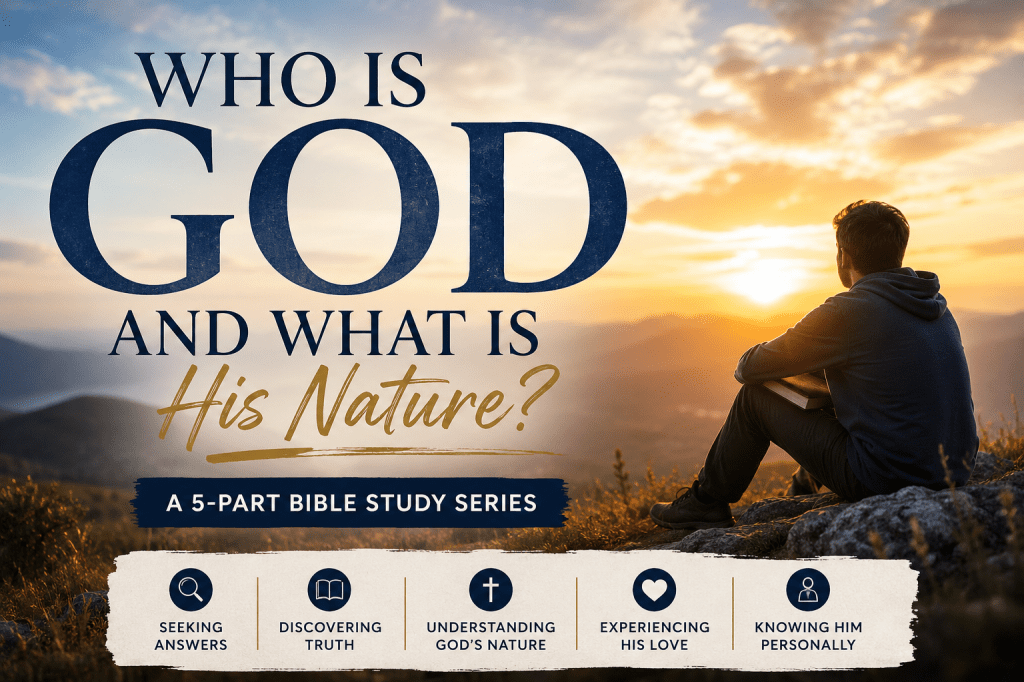
A Five-Part Journey for Seekers, Skeptics, and New Believers
Series Introduction
Humanity has spent centuries searching for God through philosophy, religion, science, personal experience, and countless competing beliefs. Yet one question remains and that is if God exists, who is He really?
Consider these questions:
- Is there a God?
- What is He like?
- Does He care about me?
- Why is there so much suffering?
- Can I truly know Him?
These are not merely scholarly questions. They emerge in moments of loss, uncertainty, success, disappointment, and the deep longing to understand our purpose.
Many people like me built their view of God from culture, family traditions, personal experiences, social media, entertainment, or some form of religion. Some imagine God as distant and uninvolved. Others see Him as a harsh judge. I have also been around some people that believe God can be defined however we choose.
But what if God has already revealed Himself?
What if the Creator of the universe has made Himself known?
The Bible declares that God is not hidden. He has revealed Himself through creation, through His Word, and ultimately through His Son, Jesus Christ. Rather than leaving humanity to speculate, God has chosen to reveal His character, His nature, and His plan of redemption.
This five-part Bible study series is for those exploring Christianity, wrestling with questions about faith, or seeking a deeper understanding of God. Instead of focusing on traditions or denominational differences, we will examine what Scripture reveals about who God is, why He created us, and how He invites us into a relationship with Him through Jesus Christ.
Whether you are curious, skeptical, searching, or beginning your walk with Christ, this study will help you discover who God says He is.
As we begin, it may be helpful to consider why this question became so important in my own life.
My Journey: Believing in God but Not Knowing Him
For much of my life, I believed that there was a God that existed. And If someone had asked me whether I believed in God, my answer would have been yes. I knew His name. I had heard Bible stories before, attended church services for a short time and I believed there was a Creator.
But there was a significant problem with this that would lead me to where I am now.
I believed in God without truly knowing Him.
Looking back, I realized that my understanding of God was shaped more by my own assumptions, experiences, and desires than by Scripture. I knew about God, but I did not know God’s character. I had information about Him, but I did not have a relationship with Him.
For decades, I chose my own path. I pursued what I thought would satisfy me. I made many poor decisions, followed worldly desires, and sought fulfillment in places where it could never truly be found.
The truth is that believing God exists is not the same as knowing Him.
The Bible tells us that even demons believe God exists (James 2:19). Intellectual agreement is not saving faith. God desires something deeper than mere acknowledgment. He desires a relationship.
Everything began to change when I stopped trying to go against God and the image I saw God as and started allowing Scripture to reveal who He truly is.
I discovered a God who is holy yet merciful.
A God who is just yet compassionate.
A God who knows every failure of my past and still extends grace through Jesus Christ.
A God who does not merely make people better, He makes them new. He made me new,
As I came to understand God’s nature, I began to understand myself, my need for a Savior, and the incredible gift of salvation found in Jesus Christ.
My prayer is that this series helps you do the same.
One of the clearest places where God reveals His own character is found in the passage that serves as the foundation for this series.
Our Foundation Passage
Exodus 34:6-7 (NKJV)
“And the LORD passed before him and proclaimed, ‘The LORD, the LORD God, merciful and gracious, longsuffering, and abounding in goodness and truth, keeping mercy for thousands, forgiving iniquity and transgression and sin, by no means clearing the guilty, visiting the iniquity of the fathers upon the children and the children’s children to the third and the fourth generation.’”
I found that these two verses give us the most important descriptions of God’s character in the entire Bible. In many ways, this passage serves as God’s own self-introduction.
Rather than allowing humanity to speculate about who He is, God tells us Himself.
To understand the depth of these words, it is important that we examine and understand the circumstances in which God spoke them.
The nation of Israel had just committed one of its greatest failures.
While Moses was receiving the Law on Mount Sinai, the people grew impatient and created a golden calf to worship. This was a direct violation of God’s commandments and a shocking act of rebellion after all God had done to deliver them from Egypt.
Israel deserved judgment.
Yet Moses interceded for the people and pleaded for God’s mercy.
In Exodus 33, Moses makes an extraordinary request:
“Please, show me Your glory.” (Exodus 33:18)
God responds by revealing His character. Notice that God does not primarily reveal His glory through displays of power, thunder, earthquakes, or fire.
Instead, He reveals His glory through His nature.
When God describes Himself, He begins with His character.
With that setting in mind, we can now look more closely at what each phrase reveals about who God is. Here is the breakdown and how to interpret the verses.
“The LORD, the LORD God”
The repeated name emphasizes God’s authority, sovereignty, and covenant relationship with His people.
God is not merely a higher power. He is the eternal, self-existent Creator who personally engages with humanity.
“Merciful”
The Hebrew word carries the idea of deep compassion.
God sees human suffering and responds with compassion rather than indifference.
“Gracious”
Grace is God’s undeserved favor.
God gives blessings that people do not earn and could never deserve.
“Longsuffering”
This means patient and slow to anger.
God does not immediately execute judgment when people sin. He patiently calls them to repentance.
“Abounding in Goodness and Truth”
God’s love is limitless, and His truth is absolute.
Unlike human beings, God never lies, changes, or breaks His promises.
“Keeping Mercy for Thousands”
God delights in showing mercy.
His compassion extends far beyond a single generation.
“Forgiving Iniquity and Transgression and Sin”
Three different words are used to describe human wrongdoing.
God is declaring that no category of sin is beyond His ability to forgive when people repent and turn to Him.
“By No Means Clearing the Guilty”
God is loving, but He is also just.
A holy God cannot simply ignore sin.
This creates the central tension of the Bible:
How can God be both perfectly loving and perfectly just?
The answer is found in Jesus Christ.
At the cross, God’s justice and mercy meet together. Jesus paid the penalty for sin so that guilty sinners could be forgiven without compromising God’s holiness.
Understanding God’s character is not merely an intellectual exercise; it should shape the way we live and respond to Him.
What does this passage teach us today?
1. God Wants to Be Known
God voluntarily revealed Himself to Moses. He is not hiding from humanity.
2. God’s Character Is Better Than Most People Imagine
Many people see God as either only loving or only judgmental.
The Bible reveals both His mercy and His justice.
3. God’s Mercy Is Available to Everyone
No matter your past, God’s grace is greater than your failures.
4. God’s Justice Means Our Choices Matter
God takes sin seriously because He is holy.
5. Jesus Is the Full Revelation of God’s Nature
When we look at Jesus, we see God’s mercy, truth, grace, holiness, and love displayed perfectly.
As Jesus said:
“He who has seen Me has seen the Father.” (John 14:9 NKJV)
Having established this foundation, let’s look ahead to the questions we will explore throughout the rest of the series.
What You Will Discover in This Series
Part 1: Does God Exist and Can We Know Him?
Part 2: What Is God Really Like?
Part 3: If God Is Good, Why Is the World Broken?
Part 4: What Has God Done to Restore Us?
Part 5: Can I Know God Personally?
By the end of this journey, my hope is that you will not simply know more facts about God. My prayer is that you will come to know Him personally through Jesus Christ and discover that the God who created you is also the God who loves you, pursues you, and invites you into a relationship with Him.
 GRATEFUL JOURNEYS!
Leave a comment